


In the rapidly expanding world of fiber optics, “one size fits all” rarely applies to every deployment. While a robust standard unit can cover the majority of needs, specific network architectures like those requiring Cable TV integration or next-generation 10G speeds demand specialized hardware.
VSOL’s flagship model, the V2801Q 2.5GbE XPON ONT, has long been a bestseller, celebrated for bringing 2.5Gbps speeds to the masses. Building on this success, VSOL has developed two distinct models derived from this lineage: the V2801T and the V2901Q-A.
In this post, we will dive into how these three models differ and which application scenario each one is perfectly suited for.

>> Contents
The Foundation: V2801Q XPON 2.5GbE Security ONT
To understand the evolution, we must first look at the baseline. The V2801Q is designed to unlock the full potential of Gigabit networks. It distinguishes itself with a 2.5GbE LAN port, allowing downstream data to flow faster than the standard 1GE limit found on older ONUs.

It is a “Security ONT,” featuring a built-in firewall, Anti-DDOS protection, and access control lists (IP/MAC filtering) to prevent rogue devices from compromising the network. Furthermore, it is ruggedized with a Wide Temperature Design, capable of operating stably between -10°C and 55°C.
Target Scenario: This is the ideal “All-Rounder” for high-speed FTTH (Fiber to the Home) and FTTO (Fiber to the Office) where pure internet speed and network security are the priorities.
Evolution 1: V2801T XPON + 1GE + CATV ONU
The Choice for Triple-Play Services
While the V2801Q focuses on raw data speed, the V2801T was developed for Fixed-Line Operators who need to deliver television alongside internet services.
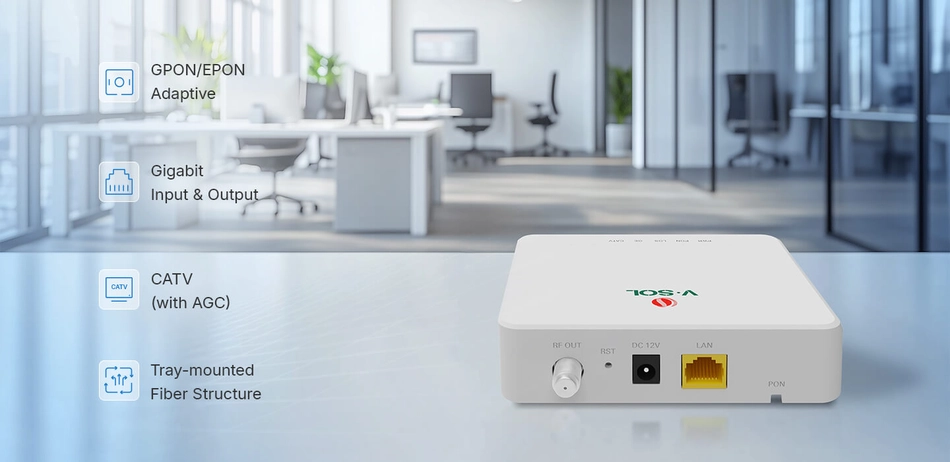
Key Differences from V2801Q:
- CATV Integration: The most visible difference is the addition of an RF interface for Cable TV. It supports AGC (Automatic Gain Control) and allows for remote control On/Off management.
- Interface Adjustment: Unlike the Q model’s 2.5GbE port, the V2801T utilizes a standard 1GE (Gigabit) Auto-negotiation port. This trade-off optimizes the device for residential “Triple-play” scenarios (Voice, Data, Video) where 1Gbps data is sufficient alongside the TV signal.
- Physical Design: The V2801T adopts a Tray-mounted Fiber Structure. This design provides space-saving cable storage, enhancing safety and reducing the risk of fiber faults during installation.
Target Scenario: The V2801T is perfect for residential deployments where the ISP provides traditional Cable TV service over the fiber network alongside a standard Gigabit internet plan.
Evolution 2: V2901Q-A 10G PON + 2.5GbE ONU
The Choice for Ultra-Broadband Future-Proofing
As ISPs upgrade their backend infrastructure from Gigabit to 10 Gigabit, the customer premise equipment (CPE) must keep up. The V2901Q-A is the high-performance evolution, designed for XG-PON and XGS-PON networks.

Key Differences from V2801Q:
- Next-Gen Uplink: While the V2801Q uses XPON (adaptive GPON/EPON), the V2901Q-A utilizes 10G PON chipsets supporting XG-PON and XGS-PON. This allows for massive symmetrical bandwidth capabilities.
- Retaining the 2.5G LAN: Like the flagship V2801Q, this model sports a 2.5GbE LAN port to ensure the high speed from the fiber network isn’t bottlenecked at the user’s router.
- Thermal & Structural Design: Handling 10G speeds generates more heat. The V2901Q-A features a specialized Heat Dissipation Hole Design and a low-power chipset to maintain energy efficiency. Like the T model, it also utilizes the Tray-mounted design for cleaner fiber management.
Target Scenario: The V2901Q-A is tailored for AR/VR applications, 4K/8K streaming, and heavy enterprise usage. It is the necessary choice for ISPs deploying XGS-PON networks to offer multi-gigabit service plans.
Note: For more 10G ONU options, check VSOL’s V2902A and V2902A-S.
Comparison & Choosing Guide: Which Model Fits Your Network?
Here come the detailed comparison of the three models to help you clarify their differences and select the one fits your needs:
| Feature | V2801Q (Flagship) | V2801T (Multimedia) | V2901Q-A (10G Performance) |
| PON Technology | XPON (GPON/EPON) | XPON (GPON/EPON) | XG-PON / XGS-PON |
| LAN Interface | 1 x 2.5GbE | 1 x 1GE | 1 x 2.5GbE |
| CATV Port | No | Yes (with AGC) | No |
| Physical Design | Compact, Wide-Temp | Tray-Mounted | Tray-Mounted, Heat Dissipation Holes |
| Best Use Case | High-Speed Gaming & SOHO | Residential TV + Internet | Ultra-Broadband & Enterprise |
VSOL identifies three primary deployment environments. Here is how to match the model to the scenario:
- Choose the V2801Q if: You are deploying a standard high-speed internet service where security and wide-temperature reliability are the main concerns. It is the proven workhorse for diverse environments.
- Choose the V2801T if: You are a Cable TV/Fixed-Line operator. The integrated CATV port with AGC and the protective tray design make it the safest bet for residential TV+Internet bundles.
- Choose the V2901Q-A if: You are building an XGS-PON network. For premium tier customers requiring ultra-low latency for gaming or massive bandwidth for enterprise cloud applications, the combination of 10G PON and 2.5GbE is essential.
By leveraging the V2801Q as a base and evolving it into the specialized V2801T and V2901Q-A, VSOL ensures that whether the priority is video integration or 10G speed, there is a dedicated device ready for the job.
Conclusion
VSOL has successfully expanded its product portfolio by taking the robust foundation of the V2801Q and adapting it for specific market demands. Whether you need the triple-play versatility of the V2801T, the cutting-edge speed of the V2901Q-A, or the proven reliability of the V2801Q, there is a tailored solution for your deployment scenario.
>> Explore more VSOL’s ONU/ONT products.


