


As FTTH networks continue evolving, choosing the right GPON ONU is no longer just about selecting the cheapest terminal device available. Today’s broadband environments involve higher traffic loads, Wi-Fi 6 and Wi-Fi 7 deployment, increasing numbers of connected devices, and growing user expectations for low-latency, stable connectivity. Under these conditions, an ONU directly affects not only internet speed, but also network stability, future scalability, and long-term operational costs.
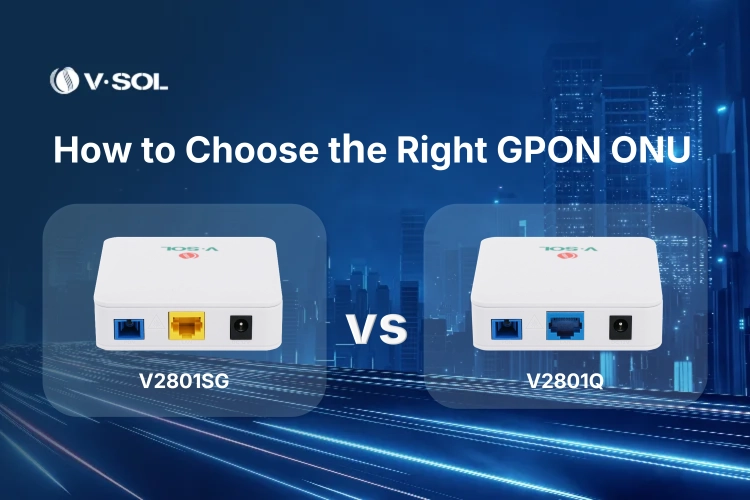
The VSOL V2801SG and V2801Q are two compact XPON ONUs designed for different deployment priorities. Although both support GPON/EPON dual-mode compatibility and carrier-grade management functions, they target different bandwidth strategies and network upgrade paths. Instead of simply comparing specifications, it makes more sense to evaluate them through the key factors that actually matter when choosing a GPON ONU.
>> Contents
Why ONU Selection Matters in FTTH Networks
In a GPON network, the ONU serves as the bridge between the optical network and user devices such as routers, PCs, IP phones, TVs, and surveillance systems. Because of this, ONU capability directly impacts:
- Actual bandwidth delivery
- Service stability
- Remote maintenance efficiency
- Traffic management
- Future upgrade flexibility
A poorly matched ONU can easily become the bottleneck of an otherwise high-performance FTTH network. Therefore, selecting the right ONU should always be part of overall network planning rather than a simple hardware purchase.
1. Start with Bandwidth Requirements
The first factor to evaluate is bandwidth demand, especially the Ethernet interface speed. While many deployments still operate efficiently within Gigabit environments, others are already moving toward multi-gigabit access.
V2801SG: Designed for Mainstream Gigabit FTTH
The V2801SG features a 1GE Ethernet port, making it suitable for standard FTTH deployments where stable Gigabit connectivity remains the primary requirement. For many residential and SMB environments, this is still more than enough for:

- IPTV and video streaming
- Video conferencing
- Online learning
- Smart home systems
- POS terminals
- IP surveillance
Its positioning makes it a practical option for operators prioritizing deployment efficiency and cost control.
V2801Q: Built for Higher-Bandwidth Environments
The V2801Q adopts a 2.5GbE Ethernet interface, targeting networks that require higher local throughput. This becomes increasingly important in environments using Wi-Fi 6 or Wi-Fi 7 routers, where wireless performance can exceed traditional Gigabit LAN limitations.

The higher-speed interface is better suited for:
- Multi-gigabit broadband plans
- NAS and large file transfer
- 4K/8K streaming
- Cloud collaboration
- Gaming environments
- Dense multi-device households
Even when internet subscriptions have not yet exceeded 1Gbps, a 2.5G ONU can still reduce internal network bottlenecks.
Quick Bandwidth Comparison
| Feature | V2801SG | V2801Q |
| Ethernet Port | 1GE | 2.5GbE |
| Recommended Broadband Tier | Gigabit FTTH | Multi-Gigabit FTTH |
| Best For | Residential / SMB | High-bandwidth environments |
| Future Expansion | Moderate | Stronger scalability |
Bandwidth planning should always balance current demand with expected future growth. Over-specifying increases cost unnecessarily, while under-specifying may shorten the hardware lifecycle.
2. Don’t Ignore Stability and Deployment Flexibility
Raw speed alone does not guarantee a good FTTH deployment. Long-term stability and installation flexibility are equally important, especially for ISPs managing large subscriber bases.
Both the V2801SG and V2801Q adopt compact desktop-style designs with wall-mount flexibility, making them easier to deploy in:
- Apartments
- Dormitories
- Hotel rooms
- Retail stores
- SMB offices
Their compact form factor also simplifies cable management and improves installation aesthetics.
Another important consideration is environmental reliability. ONU devices often operate continuously in enclosed or poorly ventilated spaces, where thermal stability directly affects service quality. Both models support operating temperatures from -10°C to 55°C, helping maintain stable performance in demanding deployment conditions.
Security is another area that should not be overlooked. The two ONUs support anti-rogue ONT protection and secure XPON authentication mechanisms, helping operators reduce unauthorized access risks and maintain network integrity.
Why Stability Matters
A stable ONU can help operators:
- Reduce maintenance frequency
- Lower operational costs
- Improve subscriber satisfaction
- Minimize service interruptions
In large-scale FTTH deployment, these factors often matter just as much as bandwidth specifications.
3. Check Layer 2 and Management Features Carefully
Many ONU comparisons focus entirely on hardware specifications while ignoring management capability. In reality, management functions are critical for ISPs because they directly affect deployment efficiency and maintenance complexity.
Both the V2801SG and V2801Q support important Layer 2 features including:
- VLAN
- QoS
- IGMP
- Flow control
- Storm suppression
- MAC filtering
- Port isolation
These functions help operators optimize traffic behavior, improve IPTV delivery, and maintain network stability across different service environments.
Remote Management Is Essential for ISPs
The two ONUs also support OMCI and OAM protocols, enabling centralized remote configuration and monitoring. This allows operators to:
- Provision services remotely
- Reduce on-site maintenance
- Simplify troubleshooting
- Improve operational efficiency
In addition, both models support bridge mode and router mode deployment, giving operators greater flexibility depending on network architecture requirements.
Management Feature Comparison
| Feature | V2801SG | V2801Q |
| VLAN / QoS | Yes | Yes |
| IGMP Support | Yes | Yes |
| OMCI / OAM | Yes | Yes |
| Bridge / Router Mode | Yes | Yes |
| ISP Deployment Capability | Carrier-grade | Carrier-grade |
These features position both products as professional FTTH access devices rather than simple consumer-grade optical terminals.
4. Think About Long-Term Network Upgrades
Future scalability is where the difference between the two products becomes more strategic.
The V2801SG remains highly practical for many current FTTH projects because Gigabit broadband still satisfies the majority of mainstream users. It also benefits from mature infrastructure compatibility and lower deployment cost, making it attractive for large-scale rollout.
However, network traffic continues increasing rapidly. Wi-Fi 6 and Wi-Fi 7 adoption, cloud applications, smart home ecosystems, and ultra-high-definition content are steadily pushing bandwidth requirements upward.
Under these conditions, the V2801Q offers stronger long-term scalability thanks to its 2.5GbE capability. Operators planning premium broadband services or longer hardware lifecycles may find higher-capacity ONU deployment more cost-effective over time.
Which ONU Fits Your Deployment?
Before choosing an ONU, operators should first evaluate actual deployment goals. Some FTTH projects prioritize cost-efficient Gigabit access, while others require higher throughput and stronger future scalability. Matching ONU capability with network demand is far more important than simply choosing the highest specification.
| Deployment Need | Recommended Model |
| Standard Gigabit FTTH | V2801SG |
| Cost-sensitive rollout | V2801SG |
| Wi-Fi 6/7 networking | V2801Q |
| Multi-gigabit broadband | V2801Q |
| Long-term future scalability | V2801Q |
Overall, the V2801SG is better suited for mainstream Gigabit FTTH deployment, while the V2801Q offers stronger scalability for higher-bandwidth and future-oriented networks.
Conclusion
Choosing the right GPON ONU involves much more than comparing raw speed specifications. Operators must evaluate bandwidth demand, deployment flexibility, management capability, operational stability, and future scalability together.
The V2801SG is a balanced solution for mainstream Gigabit FTTH deployment, offering reliable performance and cost-efficient scalability. Meanwhile, the V2801Q is better suited for higher-bandwidth environments and future-oriented FTTH networks preparing for Wi-Fi 6/7 and multi-gigabit services.
Ultimately, the best ONU is not simply the fastest one, but the one that aligns most effectively with actual deployment requirements and long-term network strategy.


